The Tiger Widows

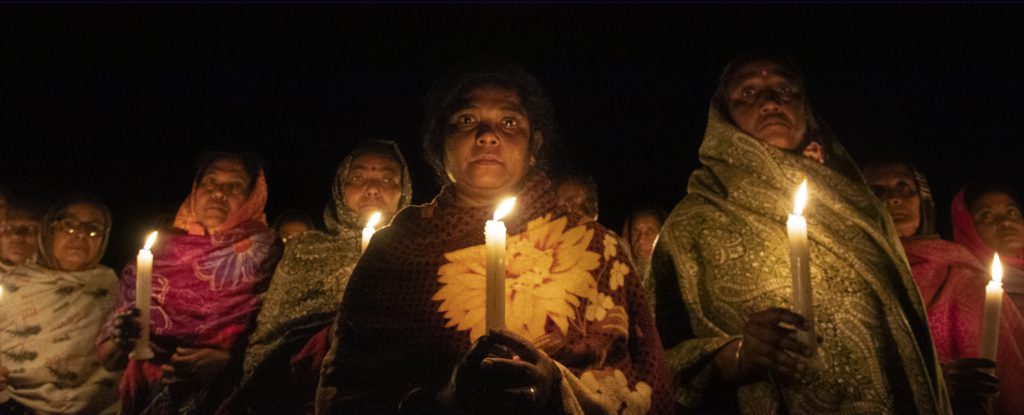
The Tiger Widows is a documentary feature film about human survival, resilience and hope against all odds in the perilous forests of “Sundarbans”, in Eastern India, facing severe threat from tigers as their homeland gradually sinks from ever-increasing climate change.

Where is “Sundarbans“?

The Sundarbans, literal meaning (Bengali: সুন্দরবন, romanized: Sundôrbôn) “beautiful forest”, is the largest mangrove forest in the world spanning 9,630 km² across the borders of Eastern India, and Bangladesh. It is also on the world’s largest delta formed by the river Ganges, Brahmaputra, and Meghna.

About 40 years ago, UNESCO inscribed the Sundarbans as a World Heritage Site. The Indian portion (Sundarban National Park) was declared a World Heritage Site in 1987. The Bangladeshi portion (Sundarbans Reserved Forest) was subsequently inscribed as a World Heritage Site in 1997.

The forests provide habitat to 453 fauna wildlife, including 290 bird, 120 fish, 42 mammal, 35 reptile and eight amphibian species.

History

The history of human settlement in the Sundarbans area can be traced back to Mauryan era (4th-2nd century BCE). However archaeological excavation at Kapilmuni, Paikgacha Upazilla, north of the Sundarbans in Bangladesh, revealed ruins of urban settlement dating back to the early middle ages.

During British colonial rule in 18 century, a vast majority of tribal populations from different parts of Bengal were relocated in Sundarbans.

Hindu Village in the Sunderbuns. F.P. Layard. Ferozepore 1843. Sketched 19th Jany. 1839, (This work is in the public domain in its country of origin and other countries and areas where the copyright term is the author’s life plus 70 years or fewer.) By Frederic Peter Layard (1818-1891) – British Library Web Site, Public Domain, https://commons.wikimedia.org/w/index.php?curid=11236726

Unique Geography and Economic Situation

The Sundarbans is intersected by a complex network of tidal waterways, mudflats and islands of mangrove forests. The area is known for the Bengal tiger (Panthera tigris), one of world’s fiercest predator.

Like any other island, locked in the waterways, the villagers are subject to a local economic structure that provides primarily two, mostly male dominated, means of earning livelihood: fishing and honey collection, both requiring them to enter the protected forests. As a consequence, the region has the highest magnitude of human-wildlife conflict, a significant risk in a region known for its Royal Bengal tigers. This has given rise to a community of 5000+ women who lost their husbands to tiger attacks. With no other means to earn, these women, also known as tiger widows, are either forced to go back to the same forests that took their husbands’ lives and/or heavily depend on the island’s local biological ecosystem for food. Though the latter becomes unsustainable as the shifting weather patterns continue to hinder agricultural productions.

The Sundarbans’ unique ecological and cultural context sets it apart. Its low elevation (less than 5 meters) and deltaic nature make it highly vulnerable to salinization and flooding. Historically, colonial interventions, such as the construction of embankments to support agriculture, altered the natural hydrology. These low lying islands were turned to agricultural and habitable villages during the British colonial era, when embankments were erected to protect the villages from the ocean. But the sea level has risen in the Sundarbans by an average of 3 centimeters (1.2 inches) a year over the past two decades, and the area has lost almost 12 percent of its shoreline in the last four decades. Therefore, now many of these islands are lower than the sea level, making the lives of around 7.2 million people, including both Bangladesh and India, in these forested islands precarious at best. With climate change, saltwater is creeping into drinking water sources. As the number and severity of cyclones arising from the Bay of Bengal looms large, they bring saltwater to the ponds that kill the fish, turn the agricultural lands saline, and make it harder for the communities to access fresh water. In some islands, drinking water needs to be shipped from other places while women wait for the supply. Additionally, women are forced to rely on saline water for daily chores like cooking, bathing, and cleaning—exposing them to serious reproductive health risks.

Therefore, The Tiger Widows, chronicles the story of Pushpo Mondal, a tiger widow. She is the face of the thousands of nameless and faceless tiger widows in the region fighting to survive as climate change continues to threaten their existence. Following Pushpo’s journey the film depicts how locals, specifically the women, must battle daily to protect their families as well as their land and water, in a space where the very act of living is an embodiment of resistance and persistence. 

Director’s View

The enigma of Sundarbans, the world’s largest mangrove forests, had always enchanted me. I remember when I was young, I visited a very remote island of Sundarbans. It took me six hours and three modes of transport to cover just 60 miles. During dusk as I was standing on the banks of the narrow river I could see the island opposite to me, barely a few hundred feet away across the river. That island was one of the 52 islands of Sundarbans where Royal Bengal Tigers roam freely in their native habitat of dense mangrove forests. That feeling of being so close to a dangerous predator who might be hiding in the dense mangroves and is just a swim away, never left me.

It was also at that time I learnt about the Tiger Widows – women who lost their husbands due to tiger attacks in Sundarbans. These deaths were such a common thing among the locals, that they coined a special term for them. 

The people in those islands of Sundarbans are extremely poor by the traditional definition of economics and that’s the reason they go to the dangerous forests just to earn a living. But despite their circumstances they are rich in their culture, happiness and their local ecosystem. The love and warmth I received from the wonderful people of this beautiful land moved me. 

Many years later, I heard the news of a super hurricane “Aila” devastating the Sundarbans. Then came other super hurricanes in quick succession. Sadly I found out that the beautiful Sundarbans, located on a small corner of the world map, is one of the worst sufferers of climate change. Sea levels are rising rapidly, water is getting increasingly salinized and devastating hurricanes are increasing in frequency and power. 

The whole vision of creating this film came when I met a fellow filmmaker, Elja Roy who is integral in bringing this project to life. Back in 2017, Elja did her thesis project in Sundarbans on the local people and their musical traditions.

As she filmed in Sundarbans, she stayed in the home of Arjun and her wife Pushpo. Apart from hosting her, Arjun also helped Elja to create this documentary. He was vocal and forthcoming on his own thoughts and viewpoints about the suffering of locals in Sundarbans, specifically talking about why people need to go to dangerous forests and pay with their lives, how their wives become “Tiger Widows” and suffer in silence.

However, within a year of giving this interview, Arjun himself was killed by a tiger while trying to earn a living. Pushpo, his wife, became a “Tiger Widow”.

When I heard about this and saw Elja’s existing footage of Arjun, talking about the fight of Tiger Widows, I felt that this story of Pushpo and The Tiger Widows needs to be told to the world, especially when today they are fighting another massive threat climate events. A threat that they didn’t create, but is forcing the very land that they call home, to gradually sink under the water through increased severe cyclones, storm surges, higher water salinity and extreme heat. 

This story, though local to the Sundarbans, is not very different from other low lying areas of the world from Indonesia to Egypt to the United States. The local population everywhere is under dire pressure from climate events. 

But Pushpo doesn’t know all these, she fights, she cries, she smiles, she lives. 

I didn’t want to make The Tiger Widows as just a documentary film. But I want it to direct people’s attention to this hidden corner of the world and help create a view that we share the same earth. 

COMING SOON

Leave a Reply

Your email address will not be published. Required fields are marked *